Options Skew: Reading Skew, MM Skew, and Legacy Skew
Not every option on a stock trades at the same implied volatility. Options at different strikes carry different IV, and the shape of that pattern — the skew — is one of the clearest windows into how the market is pricing fear versus greed. BigShort distills the directional side of that surface into three reads: Skew, MM Skew, and Legacy Skew. This guide explains skew in plain terms, then maps each of the three to what it tells you.
What Implied-Volatility Skew Is
Implied volatility is the market's estimate, baked into an option's price, of how much the underlying will move. If IV were the same at every strike, the volatility curve would be flat. In practice it almost never is.
Instead, demand piles up unevenly. Traders reaching for downside protection (buying puts to hedge a portfolio) bid up the implied volatility of lower strikes. Traders reaching for upside exposure (buying calls to chase a rally) bid up the implied volatility of higher strikes. The result is a lopsided curve, and that lopsidedness is the skew.
Read simply:
- Heavier downside IV — puts are relatively expensive. The market is paying up for protection; fear is being priced in.
- Heavier upside IV — calls are relatively expensive. The market is paying up for upside; demand is chasing the move higher.
Skew is not a forecast. It is a snapshot of where option demand is concentrated right now — a read on the balance between the two sides. When that balance shifts, it often shifts before price does, which is why traders watch it.
Skew — Market Pricing of Upside vs. Downside
The Skew read tracks the balance directly. Per the product definition, Skew tracks how the market prices upside exposure against downside protection.
In other words, it condenses the whole "are puts or calls being bid up more" question into a single running read. When the market is willing to pay more for downside protection than for upside exposure, that shows up here — and vice versa. It is the broad, market-wide expression of the volatility surface's directional tilt.
🔎 Looking Closer: Skew reflects collective demand — every participant hedging, speculating, and rolling positions across the chain. It tells you how the crowd is currently pricing the two tails against each other, not which way price will go next.
MM Skew — Which Side Market Makers Quote More Defensively
Where Skew reads the whole market, MM Skew narrows the lens to the dealers. Per the product definition, MM Skew shows which side market makers quote more defensively.
Market makers quote both sides of the book and manage the inventory risk they take on. When they widen or shade their quotes to protect against one side more than the other, they are signaling where they see the greater risk. MM Skew surfaces that defensive posture: it shows which side — upside or downside — the dealers are guarding more carefully.
💡 Why it matters: The broad market and the dealers do not always lean the same way. When Skew and MM Skew agree, the read is cleaner. When they diverge, it is worth noticing — the crowd and the people warehousing the risk are pricing the two sides differently.
Legacy Skew — the Original Calculation
BigShort's skew methodology has evolved, but the original calculation is still available for traders who want continuity with older reads. Per the product definition, Legacy Skew switches the pane to the original BigShort skew calculation, kept for continuity with historical reads. A zero bar means "no fresh reading," not neutral.
That last point is the one to remember. On Legacy Skew, a zero bar does not mean the market is balanced — it means there is no fresh reading for that bar. Treat a zero as an absence of data, not as a neutral signal. Reading a zero bar as "the skew is flat here" would be a misread.
⚙️ When to use it: Reach for Legacy Skew when you are comparing against historical charts or notes that were built on the original calculation. For a current read, the standard Skew and MM Skew are the primary views.
Skew and the Bigger Volatility Surface
Skew does not exist in isolation. It is one slice of the full volatility surface — every strike and expiry, each with its own implied volatility — and the shape of that surface is what determines where dealer gamma concentrates. That connection is why skew and gamma are two views of the same underlying positioning.
The gamma side of the surface, including Net GEX (dealers' total net gamma exposure across the chain), the walls, and the Gamma Flip, is documented in the Gamma, Dealer Hedging master article. Skew tells you how the market is pricing the two sides; gamma tells you how dealer hedging of that positioning shapes price levels.
Where to Find It
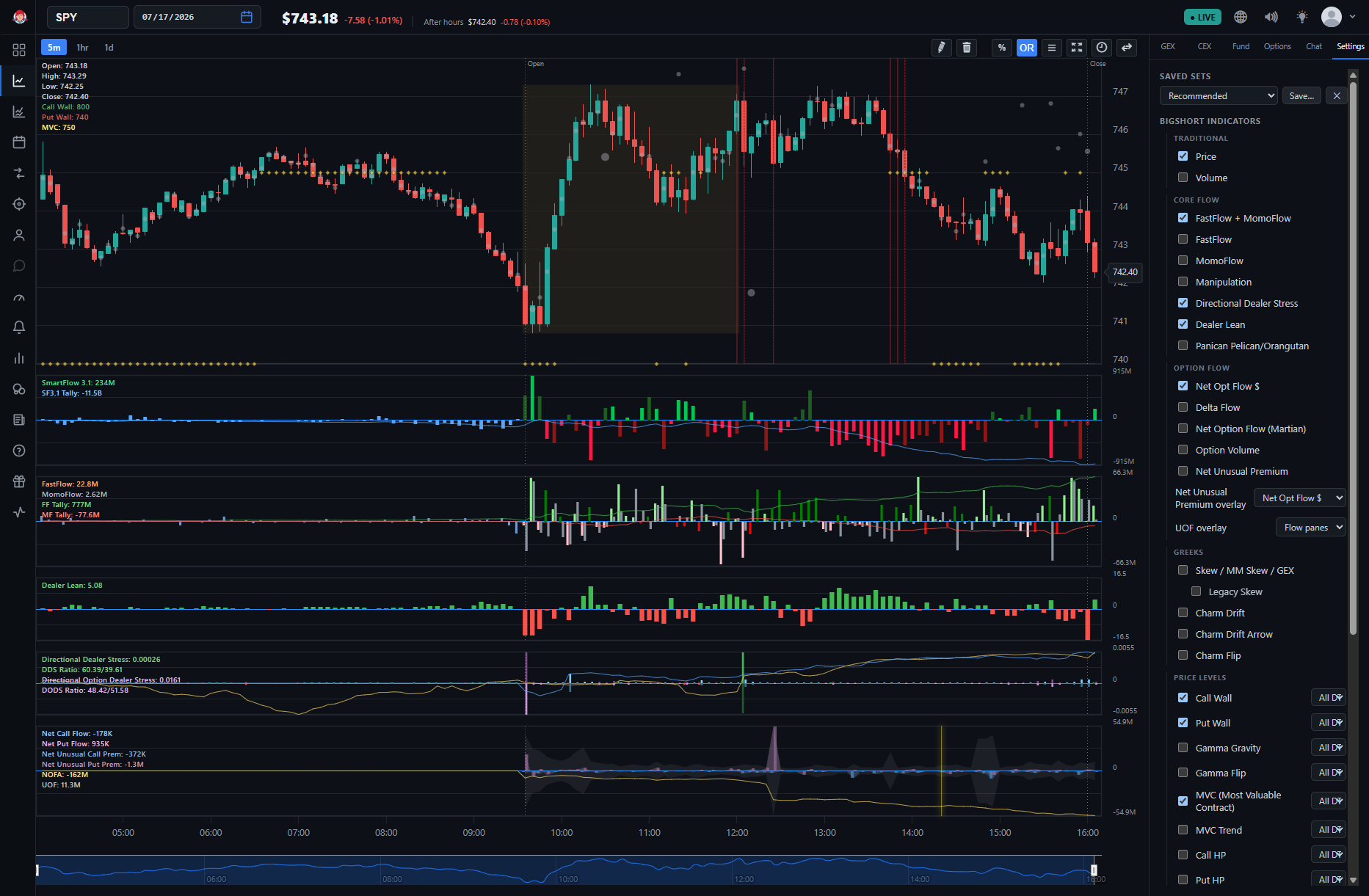
You'll find these under ⚙️ Settings → Greeks:
- Skew and MM Skew live in the combined Skew / MM Skew / GEX pane. (The Net GEX part of that same checkbox is covered in the Gamma, Dealer Hedging article.)
- Legacy Skew is a separate toggle that switches the pane to the original calculation.
How to Use It
- Read the balance. Start with Skew — is the market paying up for downside protection or for upside exposure? That tells you which way the option crowd is currently leaning.
- Check the dealers. Compare against MM Skew to see which side market makers are quoting more defensively. Agreement sharpens the read; divergence is a flag worth noting.
- Mind the zero on Legacy. If you switch to Legacy Skew, remember a zero bar means no fresh reading, not a neutral market. Don't trade a data gap as a signal.
- Confirm with flow. Skew is context, not a trigger. Combine it with real-time flow — Net Option Flow — and with the gamma levels it helps shape. Confluence is king.
- Gamma, Dealer Hedging — the gamma side of the same volatility surface, including Net GEX and the key price levels
- Net Option Flow — the real-time flow to confirm what skew is pricing in