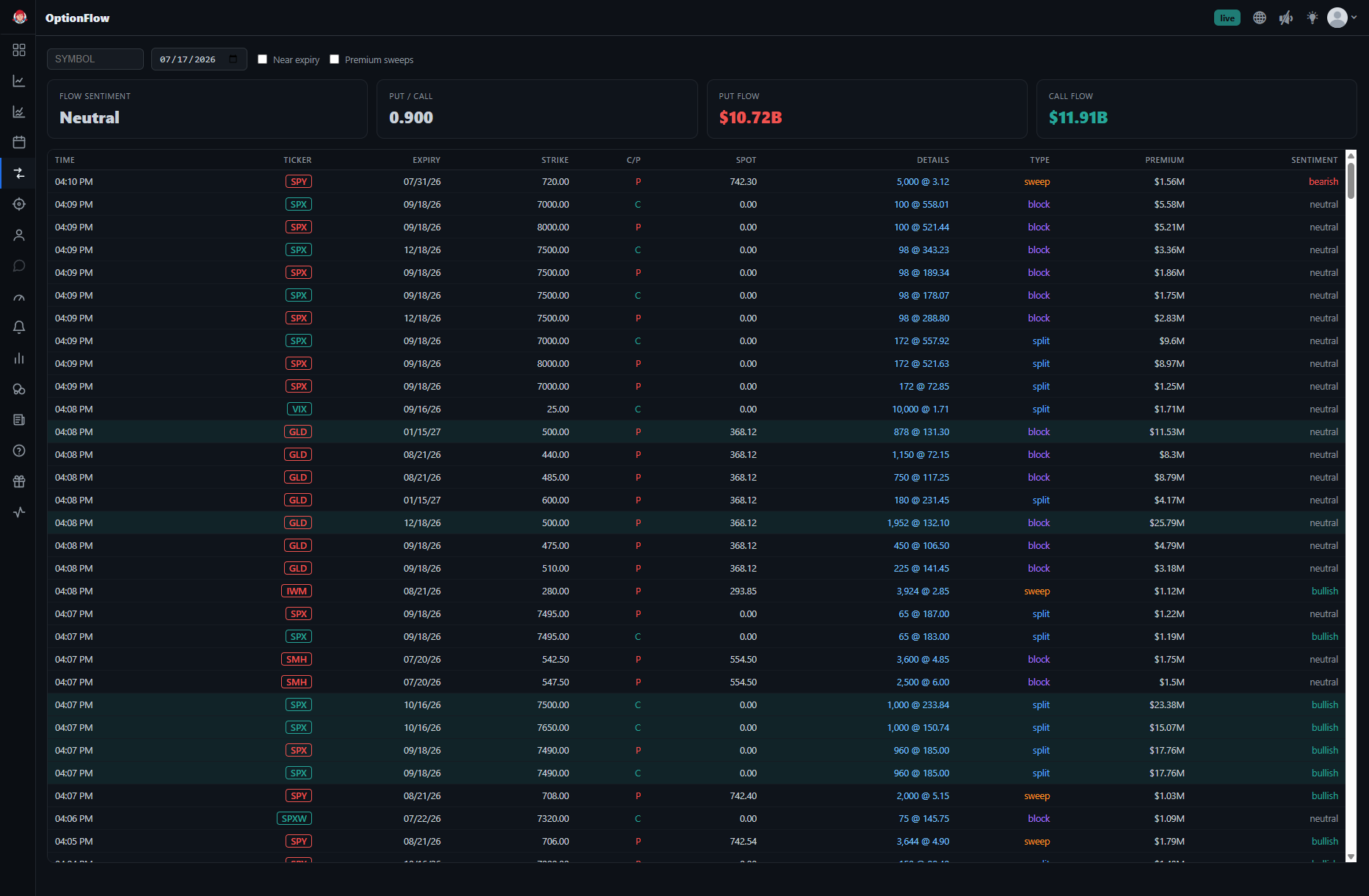
Options flow shows you where professional traders are placing bets — before price moves. BigShort's OptionFlow tab makes this data actionable in real time.

What Is Options Flow?

Options flow tracks the buying and selling of options contracts across the market. When large institutions or well-capitalized traders take a position, they often do it through options — which leaves a footprint in the flow data before price reflects the move.

Unusual options flow — large, aggressive trades that deviate from normal volume — is often a leading indicator of price direction. BigShort surfaces this data in the OptionFlow tab the moment it happens.

What the OptionFlow Tab Shows

The OptionFlow tab displays real-time options transactions, filtered and scored by BigShort to surface the most relevant signals. Key things to watch:

Bullish flow: Large call sweeps, aggressive call buying, or heavy put selling. Consistent bullish flow in a ticker signals institutions are betting on upside.

Bearish flow: Large put sweeps, aggressive put buying, or call selling. Heavy bearish flow often precedes downside moves.

Sweep vs. block: A sweep is a large order split across multiple exchanges to fill quickly — it signals urgency and tends to be directional. A block is a single large negotiated trade.

Premium: The dollar value of the options trade. Higher premium = more conviction. A $1M+ sweep carries more weight than a $10k trade.

How to Read the OptionFlow Tab

  1. Open the OptionFlow tab in BigShort's main navigation
  2. Filter by ticker to focus on a specific stock, or watch the full market flow
  3. Look at direction: are most large trades calls (bullish) or puts (bearish)?
  4. Note the sentiment score: BigShort highlights net bullish or bearish bias in the flow
  5. Cross-reference with Net Option Flow: OptionFlow shows individual trades; Net Option Flow aggregates them into a directional read

Using OptionFlow for Trade Timing

Options flow is a leading indicator — it often moves before price. Here's how to use it:

For confirmation: If you see a setup forming (e.g., a support level holding), look for bullish OptionFlow to confirm institutions are positioned the same way. A call sweep near support is a green light.

For discovery: Scan OptionFlow for tickers with unusual activity you weren't already watching. Unusual flow in a quiet stock often precedes a catalyst.

For exits: When bullish flow reverses — large put sweeps appear while you're in a long — that's institutional money rotating out. Tighten up or exit.

Combining OptionFlow with Other BigShort Indicators

OptionFlow is most powerful when confirmed by other signals:

SignalWhat it adds
Net Option FlowAggregate directional bias across all options
DarkflowDark pool positioning — confirms or contradicts OptionFlow
FastFlow / MomoFlowMomentum confirmation for entry timing

When OptionFlow, Net Option Flow, and Darkflow all point the same direction — that is a high-conviction setup.

Key Takeaways

  • Options flow shows institutional positioning before price moves
  • Bullish sweeps (large, aggressive call buying) often precede upside
  • Bearish sweeps (large, aggressive put buying) often precede downside
  • Combine OptionFlow with Net Option Flow and Darkflow for the highest-conviction reads
  • Use flow as confirmation for setups, not as a standalone signal

Disclaimer:
The information provided in this article is for educational and informational purposes only and should not be considered as financial advice. BigShort does not provide personalized investment recommendations or advice, and you should not make any trading or investment decisions based solely on the content of this article. Trading in the stock market involves significant risk, including the potential loss of your entire investment. Past performance of our tools, indicators, or any referenced strategies does not guarantee future results. Always do your own research and consult with a qualified financial advisor before making investment decisions. Use of our platform and its features is at your own risk.